


The market for dredging and hydraulic engineering works has an international character. That is true today, but it was already the case around the turn of the 19th to the 20th century. In 1903, Ackermans & van Haaren became prominently active in Latin America.
The Port of Rosario
In 1882, the Argentine government decided to build a port at La Plata, southwest of Buenos Aires. It was an excellent field of work for various Dutch contractors specializing in hydraulic engineering. Their successes did not go unnoticed by Nicolaas van Haaren and Hendrik Willem Ackermans, who also had plans to become involved in these major projects at the other side of the Atlantic.
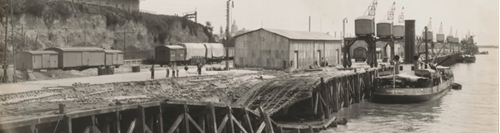
Around the turn of the century, the Argentine government asked a French consortium to build a port on the Paraná River in Rosario. Nicolaas van Haaren had already worked with the French firms of the consortium in Belgium, and was therefore engaged as a subcontractor for dredging a deep shipping channel, constructing a long dam, damming a side channel, and making bank protection along two small islands in the river.
For these works, eight Rhine ships and two tugboats were built. On March 4, 1903, the great moment arrived. Hendrik Willem Ackermans wrote in his diary: “Today the first group of workers departed for Rosario.” In the following year, several more crossings took place, bringing employees, equipment, and dredgers to Rosario. Unfortunately, not every trip went smoothly. In January 1904, the dredger Rosario II sank off the Spanish coast, with all onboard perishing. At the end of May 1904, Hendrik Willem Ackermans followed his staff to Rosario, where he was greeted emotionally. He visited the works at various locations in and around Rosario. On July 25, 1904, he returned to Antwerp. The works in Argentina were subsequently overseen locally by his brother-in-law Jacobus ‘Koos’ van Haaren. The first assignment in Rosario was completed in 1908. The dredging work involved 9 million m³ of sand, most of which was used for land elevation. Additionally, 60,000 m³ of gravel was dredged, half of which was shipped from Colón to Rosario.
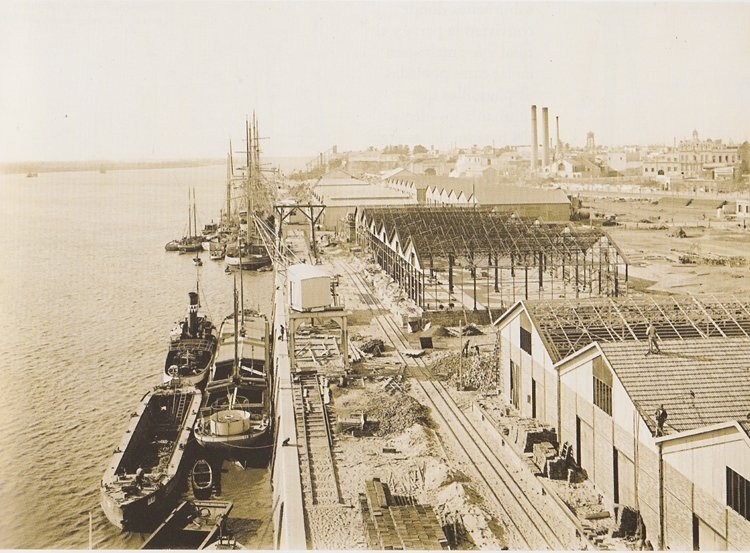
Quays at the Port of Rosario.
Latin America: 57% of group revenue
During that period, the Argentine branch of Ackermans & van Haaren also worked as a subcontractor for the expansion of the Port of Buenos Aires and carried out similar works elsewhere in Argentina.
Even after the first major assignment for the Port of Rosario, new work orders followed such as the construction of a new railway in Puerto Belgrano. For this project, the company dredged 8 million m³ of soil, almost all of which was used for raising the land. One project followed another, mainly in Rosario, but also at other ports in Argentina and in other South American countries.
By 1913, Latin America already accounted for more than 57% of the turnover of Ackermans & van Haaren, which had risen to fourth place among the top French, German, and Belgian contractors of public works, ranked by revenue, during that period.
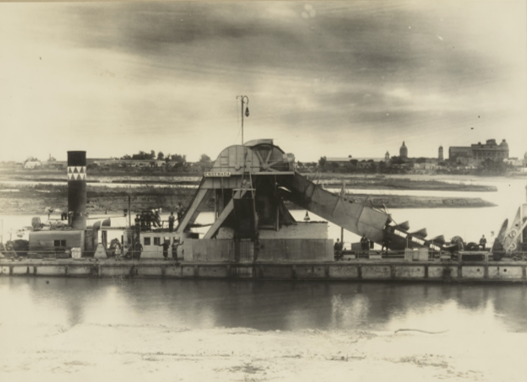
The Ensenada dredging vessel in the Delta de Parana.
Organizing and diversifying
For following-up these projects in Latin America, Ackermans & van Haaren established offices in Buenos Aires and Rosario. Initially, no legal structure was established for these offices. Everything was based on practical cooperation and trust.
At that time, there were no transportation or communication options that could support rapid and adequate follow-up of activities in Latin America from Antwerp. It often happened that the head office in Antwerp did not have recent figures about its activities in Latin America during crucial meetings. Despite the intervention on-site of a number of trusted representatives, the company faced in 1917 a loss of 1.7 million US dollars for its activities in Latin America. This led to the creation in 1918 of a dedicated company under Belgian legislation, taking responsibility for Ackermans & van Haaren's operations in Latin America. The “Société Sud-Américaine H.W. Ackermans & H. Van Haaren” was established for a duration of 30 years and was represented by the following directors: Hendrik Willem Ackermans, Henri van Haaren, and Johan van Baren. Three weeks after the creation of this company, the First World War began.
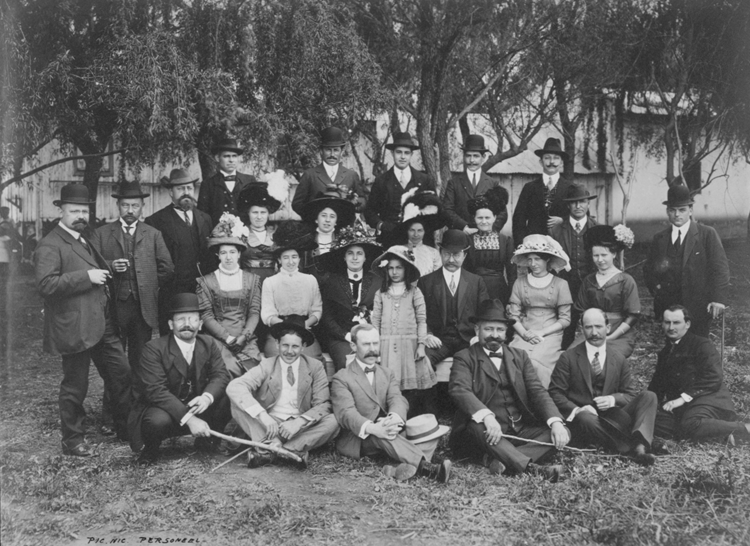
Picnic with company staff in Rosario (Koos van Haarenn, with bowler hat, is sitting in the second row, in the middle).
After the First World War, port expansions and hydraulic works were no longer a priority for the Argentine government. The SA Société Sud-Américaine H.W. Ackermans & H. Van Haaren was gradually transformed into an investment company. Despite the economic problems between the two world wars, the company achieved good results during that era. Also during and after the Second World War, the diversification strategy ensured the continued existence of the company, which held stakes in Argentina (metal, textiles, agricultural machinery, real estate, chemicals, ceramics), Morocco (real estate, construction), Cameroon (brewery), Gabon (fiberboard, financial activities) and France (public works, aviation). After earlier extensions of its duration, the company was dissolved in October 1978. The remaining assets in Argentina were sold.
This marked the end of an adventure from which Ackermans & van Haaren drew the necessary lessons for the future, continuing its international focus and diversification strategy.