



Hendrik Willem Ackermans
1855-1945
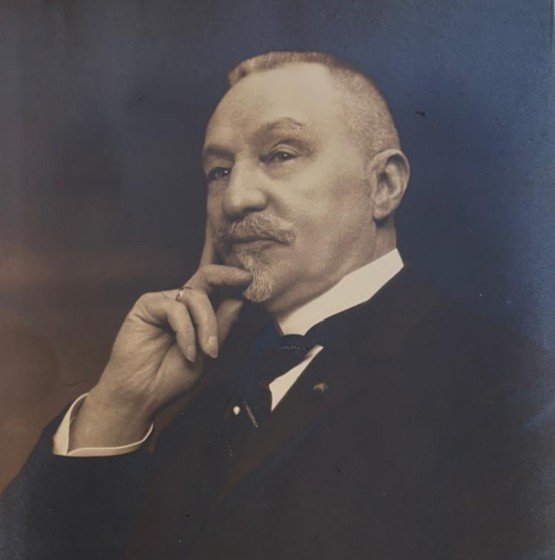
Hendrik Willem Ackermans was born on 6 April 1855 in Kerkdriel, the Netherlands, as the first child of Christina Belle and Jan Ackermans. Later, he had two brothers and three sisters. His mother worked at home. His father was a farmer, but later became a municipal receiver in Driel.
From 1866 to 1869, Hendrik Willem Ackermans first attended the boarding school of Christiaan ter Borgh in Geldrop. After three years at the Higher Civic School, he successfully completed the engineering course at the Polytechnic University of Delft.
In 1876, Hendrik Willem Ackermans joined the employ of his fellow villager Nicolaas van Haaren, a contractor of public works. He was given supervision over the execution of various projects in the Netherlands.
In the summer of 1888, he received his first assignment abroad: the study and contracting of gravel supplies for the construction of forts on the Maas in Belgium. His strong drive to successfully complete every task became immediately apparent. He personally searched for suitable timber to build piers in the Maas. He bought a pile driver and accessories himself and, early in the morning, travelled to Liège to buy horses for the works. The projects on the Maas even attracted royal interest. In October 1889, Belgian King Leopold II came to see the works. Upon leaving, he shook Hendrik Willem Ackermans' hand and said: “Eh bien monsieur, je suis toujours charmé chaque fois que je vois des hollandais” (“Well sir, I am always delighted whenever I see Dutch people”).
On 6 May 1890, Hendrik Willem Ackermans married Elisabeth van Haaren in ’s-Hertogenbosch, daughter of Nicolaas van Haaren. They had four children: Jan, Nicolaas, Maria and Christina.
Hendrik Willem Ackermans distinguished himself not only as head of various sites in the Netherlands, Belgium and other countries, but also as a driven technician who always sought innovation and improvement of materials. Neither money nor effort was spared to increase the productivity of dredgers and suction dredgers. The technical and administrative staff were also well cared for. Social unrest was extremely rare in the company.
The company of Nicolaas van Haaren became increasingly specialised in hydraulic engineering. Hendrik Willem Ackermans established supply companies (including a cement factory in Burcht and a brick factory in Brecht, both near Antwerp) or accepted important board mandates. In 1935, he became chairman of the board of the Gusto shipyard in Schiedam, one of the largest in the Netherlands. He also participated in many other enterprises, allowing him to build an impressive business empire.