



1876-1914
Infrastructure works in the Netherlands
The partnership Ackermans & van Haaren originated in Kerkdriel, the Netherlands. In the early years, Ackermans & van Haaren was mainly active in the Netherlands.
From its founding in 1876 until the turn of the century, Ackermans & van Haaren contributed to the construction of several railway lines in the Netherlands, including the lines Arnhem-Nijmegen (1877-1879), Nijmegen-Venlo (1881-1883), Lage Zwaluwe-‘s Hertogenbosch (1882-1889), and the railway bridge over the IJssel in Deventer (1886-1887).
In this initial period, the company was also involved in numerous significant Dutch waterworks, including the construction of the Ghent-Terneuzen Canal (1882) and the Merwede Canal (1888). This was a fine continuation of the technical feat that Nicolaas van Haaren, together with two partners, had achieved between 1868 and 1872 in building the piles for the bridge over the "Hollands Diep" at Moerdijk, which at the time was the longest bridge of its kind in Europe.
Ackermans & van Haaren was also a valued contractor for the infrastructure works for building military forts in the Netherlands. The company, for example, was involved in the construction of the new “Hollandse Waterlinie", the forts around Utrecht, and the defensive ring of 135 km around the Dutch capital, known as the Defence Line of Amsterdam (“Stelling van Amsterdam”).
Maas gravel brings AvH to Belgium
Taking into account the strained Franco-German relations following the Franco-Prussian War of 1870-1871, Belgium decided to further develop the rings of forts around Namur and Liège to protect itself against potential aggression between the two European powers of that period. This project was named after Lieutenant General Henri Alexis Brialmont, who had previously designed the forts around Antwerp. The execution of that plan was awarded to French contractors, who, for the supply of gravel (to make concrete), called upon several Dutch subcontractors, including Ackermans & van Haaren.
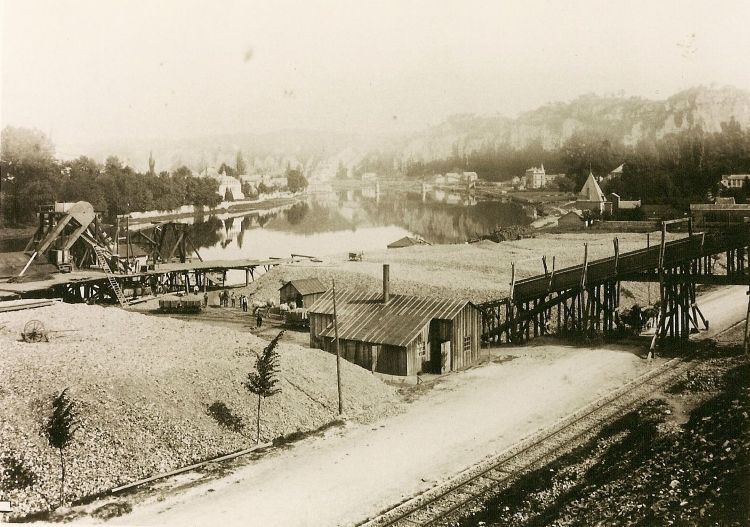
This commission represented a great opportunity for the company as it was already familiar with fort construction in the Netherlands. For Hendrik Willem Ackermans, it was his first foreign assignment, which began in the same year as his marriage to Elisabeth van Haaren. Hendrik Willem rented temporary accommodation in Namur (Place Léopold nr. 6) to closely follow the works on the forts around Namur (in Malonne and Maizeret, photo) and around Liège (in Pontisse and Barchon). Initially, the company deployed 14 ships on the Meuse for dredging and unloading gravel. That number would later be increased. On 9 October 1889, Belgian King Leopold II personally came to observe the progress of the fort construction. In 1891, these works were completed.
Docking in Antwerp
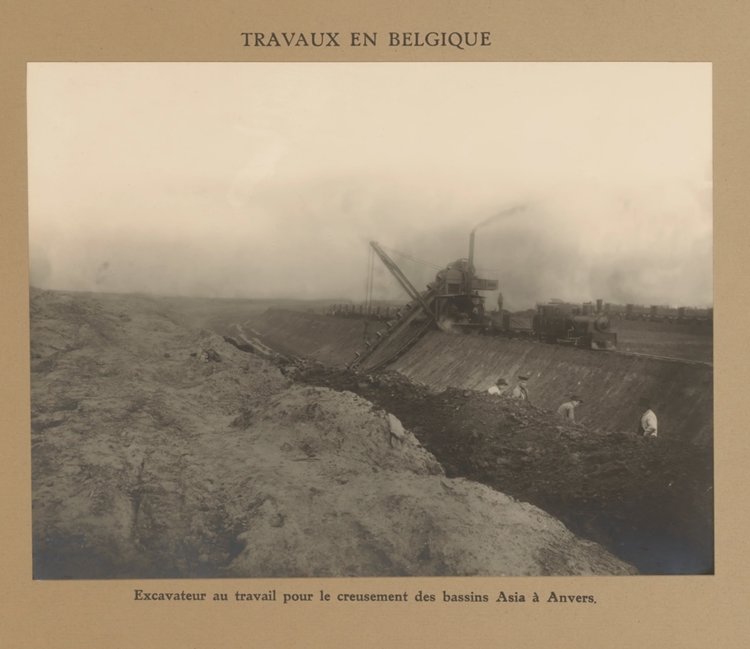
From then on, the company focused on the Antwerp area. Between 1891 and 1893, it improved the mouth of the Rupel by dredging the Lower Scheldt in Melsele and building dikes (revetment works). Between 1894 and 1911, it carried out normalization and dredging work on the Sea Scheldt between Antwerp and the Dutch border. A total of 30 million m³ of silt was dredged. As a result, sea-going vessels with large cargo capacity could reach the port more easily. In addition, many other hydraulic engineering works were carried out in the Antwerp area: raising land for industrial purposes, for building petroleum tanks and constructing a railway station yard, strengthening the quay walls in Antwerp, and building the port of Doel. During the same period, Ackermans & van Haaren also worked on the Campine Canal (“Kempisch Kanaal” - 1902-1903), the new Northern Basins (“Noorderdokken” -1903), the Wood Basin (“Houtdok” - 1908), and the widening of the Asia Basin (“Asiadok”, photo - 1907-1910).
In addition to regular hydraulic engineering works, Ackermans & van Haaren was also called upon in cases of severe flooding. On March 12, 1906, extreme weather conditions and exceptionally high tides caused dike breaches and floods along the Scheldt. Ackermans & van Haaren was engaged to close the gaps by constructing a dam near the polder villages of Kallo and Melsele.
In summary, between 1894 and 1912, the company carried out dredging and deepening works on the Bath shoal, the Zandvliet passage, the Valkenisse passage, the Hemiksem channel, the mouth of the Rupel, the Valkenisse shoal, the quay walls at Herbouville Quay, Antwerp South, the Lillo shoal, “Krankeloon”, and the “Palingplaat”. (Even outside the Antwerp region, important projects were already carried out before World War I, such as the expansion of the ports in Brussels and Ostend).
Anchored in Antwerp
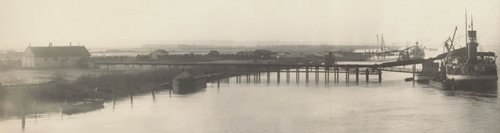
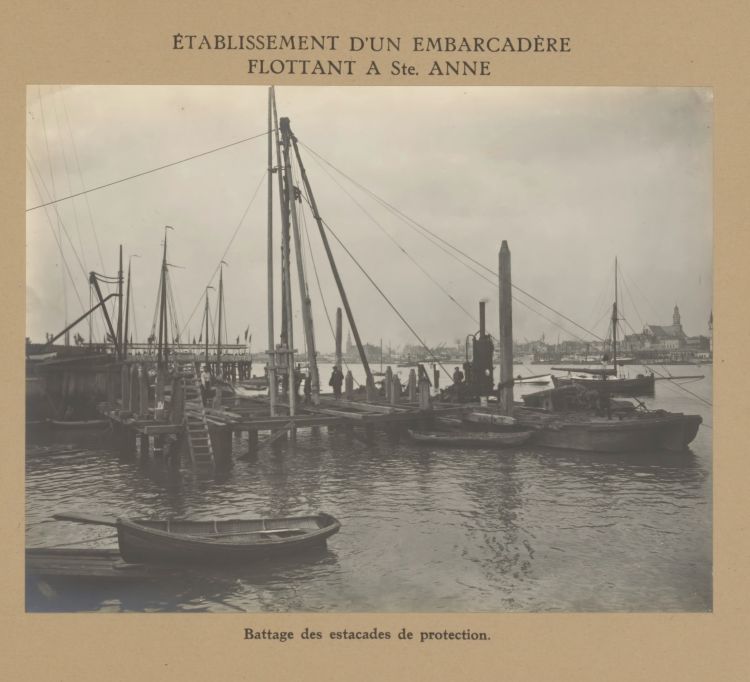
The sand from the dredging works that Ackermans & van Haaren carried out in the Scheldt between 1912 and 1923 was sprayed onto the “Borgerweertpolder”, between the villages of Sint-Anna, Zwijndrecht, and Burcht. This created ‘Sint-Anneke-plage’. Due to the interruption of World War I, the transfer of the Borgerweertpolder to the City was only approved in 1923, which is why Sint-Anneke-plage (photo) has since been officially called Antwerp Beach: for many people from Antwerp, a pleasant recreational area in the summer to sunbathe and swim in the Scheldt.
On a personal level, the death of Nicolaas van Haaren was recorded during this period, on August 30, 1904, in Neerbosch near Nijmegen (the Netherlands). His son, Henri van Haaren, was already living in Antwerp at Mechelse steenweg number 120. The family of Hendrik Willem Ackermans had also settled in the Antwerp area during this time. From June 1900, the castle of Niel was rented until the move to Pulhof Castle in Wijnegem in July 1909. The company office was already established in Antwerp, initially at Edelinckstraat number 6 and then at Willemsstraat.