


The partnership between Nicolaas van Haaren and Hendrik Willem Ackermans took on a structural form in 1876. From that point forward, they were partners in all major projects. As was customary in the dredging sector and contracting business, separate companies were established for each infrastructure project for the duration of the project. Nicolaas and Hendrik Willem joined these companies together, but in a personal capacity, alongside other partners who also participated in each venture.
‘Maatschappen’ – ‘general partnerships’
In the Netherlands of the 19th century, a general (non-incorporated) partnership (‘maatschap’) was the most obvious legal form of collaboration between contractors. Each fellow brought labor, money, goods, or goodwill to a factual enterprise that was not a legal entity in itself.
A good example is the partnership van Seters & van Haaren, established in 1887 with the aim to extract sand for the expansion of ’s Hertogenbosch. When Hendrik Willem Ackermans and Nicolaas van Haaren started infrastructure works in Belgium in 1888, the companionship with Seters proved a hindrance along the way to setting up a corporation for these works.
The 'large and small corporations'
Only in 1895 was an agreement reached and two new corporations were formed in Belgium. Hendrik Willem Ackermans used to refer to them as the ‘grote sociëteit’ (the large corporation) and the ‘kleine sociëteit’ (the small corporation).
The ‘grote sociëteit’ was used for the SA Compagnie Auxiliaire pour Entreprises de Travaux Publics and had a logistic task: the rental of equipment for the execution of public works. Beside Nicolaas van Haaren and Hendrik Willem Ackermans, there were six other shareholders: Hendrik van Haaren (Nicolaas’ son), Hendrik van Baren (son-in-law of Nicolaas), Johan van Baren (Hendrik’s son), Cornelius van Haaren (Nicolaas’ son), Jacobus van Haaren (Nicolaas’ son), and Johan Glaudemans (son-in-law of Nicolaas). This corporation was dissolved in 1912.
The ‘kleine sociëteit’ referred to the SA Entreprises de Travaux Public, which focused on the organization, coordination, and execution of the work itself. It was also responsible for preparing the tenders. We find the same eight shareholders. After prolonging, the duration of this corporation ran until 1914.
Legal vacuum
During the First World War, the corporation’s activities in Belgium were suspended and it continued operating whenever possible from The Hague, in the Netherlands, which remained neutral in this war. As of 1915, the company operated in a legal vacuum and the SA Entreprises de Travaux Public was dissolved in 1920. Due to the absence of a legal status, each venture involved enormous risk at the time, as individuals were required to act as personal guarantors.
From a previous account (“To Rosario!”), we remember that a public limited company under Belgian law was established in 1918 for a period of 30 years, with the following directors: Hendrik Willem Ackermans, Henri van Haaren, and Johan van Baren. The initial purpose of this company was to oversee activities in Latin America, but it was gradually transformed into an investment company, which was wound up in 1978.
The public limited company Ackermans & van Haaren
Back to 1915, in Belgium. Hendrik Willem Ackermans and his son Jan, a lawyer, sought to strike a balance between the parties involved in order to establish a new company. They succeeded in 1924, specifically on December 30, with the founding of SA Entreprises Ackermans & van Haaren. The board of directors consisted of: Hendrik Willem Ackermans (chairman), Jan Ackermans (secretary), Henri van Haaren, Johan van Baren, Toon Jurgens (son-in-law of Henri van Haaren), and Gust Smulders (son-in-law of Hendrik Willem Ackermans). For the day-to-day operations, Hendrik Willem Ackermans was the managing director, assisted by two executive directors: Cornelius van Haaren and Jan Ackermans.
The establishment of this company laid the foundation for today's Ackermans & van Haaren.
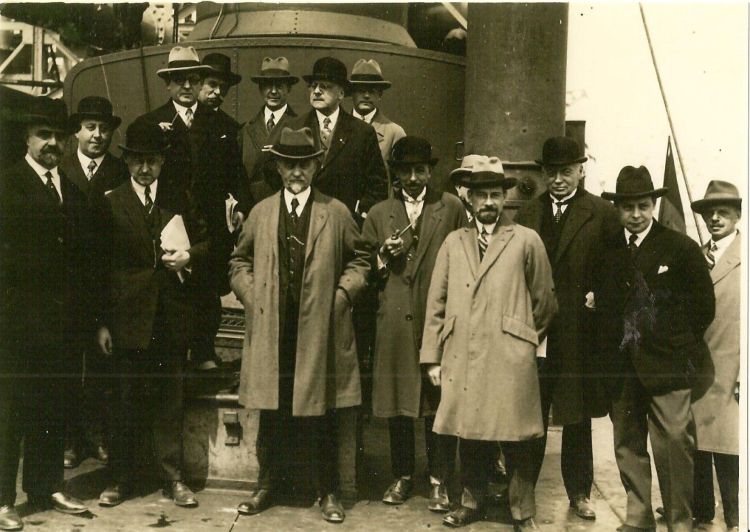
Press conference in Antwerp, 1928 (Second from left, standing: Jan Ackermans. At his left hand-side: Hendrik Willem Ackermans)